Skip to content
QuFabric

Quantum simulation, on GPUs you already own.

A self-hosted research platform for quantum algorithms, many-body physics, and quantum chemistry. Launch curated notebooks, submit Slurm-backed GPU simulations, track results, and keep data resident on your WECORE cloud.
CUDA-Q + cuQuantum ready
Slurm batch and arrays
Notebook-first workflow
Data-resident by design
Coming soon module: qsim — built from WECORE HPC, KaaS, and Cloud Server primitives.
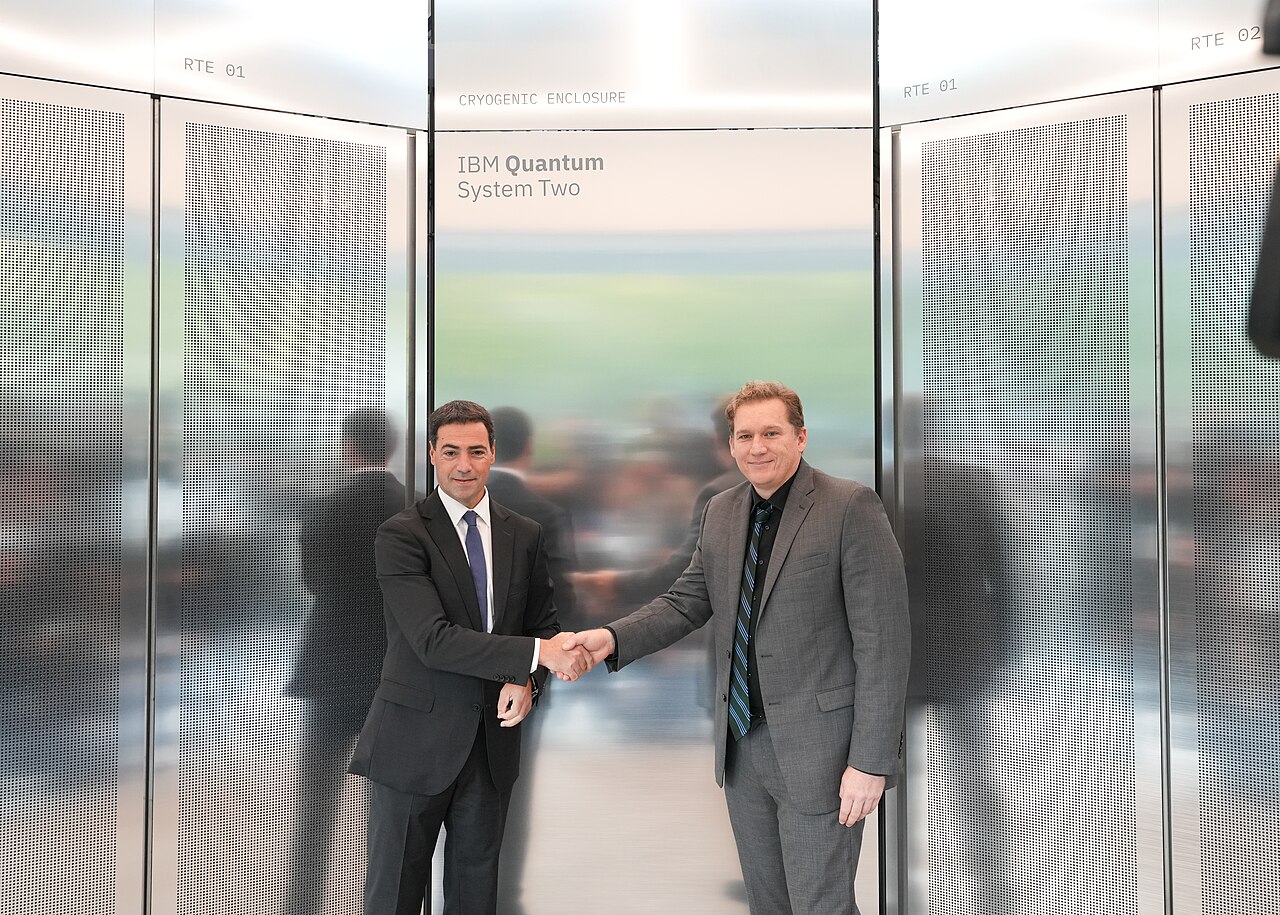
IBM Quantum System Two cryogenic quantum computer at Ikerbasque
Campaign running
vqe-lih-aer-gpu-042
Slurm GPU

Reference visual: IBM Quantum System Two at Ikerbasque, 14 Oct 2025. Author: Irekia / Eusko Jaurlaritza; CC BY 4.0.

3
Research personas
7+
Simulation engines
Multi-GPU
Execution target
Self-hosted
Deployment model
Workflow

Everything a quantum researcher needs, without leaving your cloud.

Inspired by modern quantum developer platforms, QuFabric brings projects, environments, jobs, and results into one governed self-service workspace.
01

Create a project

Group notebooks, datasets, circuits, Hamiltonians, tags, quotas, and collaborators under one durable research workspace.

02

Choose an environment

Start from curated GPU images for CUDA-Q, Qiskit Aer-GPU, PennyLane-Lightning-GPU, qsim, quimb, PySCF, and OpenFermion.

03

Run interactively or submit jobs

Prototype in Jupyter, then dispatch the same code to Slurm GPU queues, arrays, or campaign sweeps.

04

Track reproducible results

Store engine versions, resources, input files, result schemas, logs, costs, and run history with every job.

Research lanes

Curated for the way quantum teams work.

Each lane gets templates, kernels, packages, example notebooks, and resource presets tuned to the science.
Circuits + noise

Quantum Algorithmist

Deep-circuit simulation, QAOA/VQE/QML campaigns, custom noise models, state vectors, expectation values, and cross-engine benchmarking.

CUDA-Q cuStateVec Qiskit Aer-GPU qsim
Tensor networks

Many-Body Physicist

Hamiltonian time evolution, MPS/MPO workflows, contraction planning, quimb/cotengra/JAX notebooks, and distributed tensor-network experiments.

cuTensorNet quimb cotengra JAX
Molecules + VQE

Quantum Chemist

OpenFermion and PySCF workflows, fermionic mappings, UCCSD templates, GPU-accelerated classical references, and reproducible chemistry notebooks.

PySCF gpu4pyscf OpenFermion PennyLane-QChem
Platform

A thin control plane over proven open-source engines.

QuFabric is not another simulator. It is the governed product layer that assembles the best engines on your OpenStack, GPU, and Slurm infrastructure.
qsim-control self-hosted
project: molecule-vqe
env: cudaq-cuquantum-12
queue: gpu-a100
items: 128 circuits
status: RUNNING
result: expectation + logs

Curated Lab images

qBraid-style environment catalog with subject facets, kernel registration, clone-from-curated workflows, and health checks.

Job object, not raw scheduler IDs

Stable project-scoped job IDs, status history, cancellation, retries, quota depletion states, and partial-result recovery.

Campaigns and batch fan-out

Parameter sweeps and circuit batches map to Slurm arrays while staying visible as a single campaign.

Result hub

Normalized counts, statevector, expectation, and artifact outputs with schema versions, logs, metrics, and exportable handles.

Quota preflight

Estimate GPU seconds, VRAM, storage, and wallet impact before a job queues.

Self-hosted sovereignty

Run on WECORE-managed OpenStack and Slurm resources; keep sensitive circuits, chemistry inputs, and results inside the operator boundary.

Engines

Bring the research stack into one governed workspace.

The first curated images assemble the engines already used by HPC centers and quantum research teams.

Circuit simulation

CUDA-Q NVIDIA cuQuantum Qiskit Aer-GPU Google qsim

Tensor networks

cuTensorNet quimb cotengra JAX

Quantum chemistry

PySCF gpu4pyscf OpenFermion PennyLane-QChem

Workflow layer

JupyterLab Slurm Open OnDemand Prometheus/Grafana
Why WECORE

Cloud-like workflow, self-hosted execution.

Dimension
Hosted quantum clouds
QuFabric qsim
Deployment
Vendor SaaS account
WECORE OpenStack, Slurm, and GPU fleet
Data residency
Inputs and results leave your institution
Projects, runs, and artifacts stay on operator storage
Simulation control
Fixed provider images and credit meters
Curated images plus cloneable, reproducible environments
Scaling model
Provider-specific queues
Interactive notebooks, Slurm jobs, arrays, and campaign sweeps
Value
Access broker
Governed product layer over owned HPC infrastructure
FAQ

Quantum simulation questions, answered

What QuFabric is, what it is not, and how it fits WECORE infrastructure

No. QuFabric is a quantum-simulation platform. It runs simulators and research engines on GPU/HPC infrastructure you control. Optional real-QPU pass-through may come later, but the first release focuses on simulation.

Those are hosted cloud services. QuFabric borrows the polished workspace pattern — projects, environments, jobs, and results — but runs on WECORE-managed OpenStack, Slurm, and GPU resources so data stays resident.

The first curated images target CUDA-Q, NVIDIA cuQuantum, Qiskit Aer-GPU, PennyLane-Lightning-GPU, qsim, quimb, PySCF/gpu4pyscf, and OpenFermion.

Yes. The intended path is notebook-first: prototype in JupyterLab or Open OnDemand, then submit the same environment to Slurm-backed jobs or campaigns.

Every run captures project metadata, input artifacts, engine versions, selected environment, resource request, result schema, logs, timing, and quota impact.

Coming soon

Turn your GPU fleet into a quantum simulation lab.

QuFabric qsim is designed for research organizations that need a qBraid-like workflow without sending sensitive data or fixed-budget GPU capacity to a public cloud.